Saturday, 23 November 2024

South America, Days 29 to 31 - Stage 7: Sucre to Potosi, Bolivia

Before we start with this blog I wanted to put on the YouTube of Crazy Dave we've done, who we spoke to in San Pedro square in La Paz. Wifi was too poor at the last hotel, but I managed to upload it here. Have a look at this, its edited down to about 11 minutes (from about an hour). It's his experience of being locked up in probably the most lawless prison in the world. He's called Crazy Dave for a reason as you'll find out!

Day 29 Wednesday

A taxi to the bus station, cost almost as much as the bus to Potosi, but that’s just the way it is! We were there at 09.30 as instructed for a 10.00 bus which didn’t turn up till 10.10. Then took 40 minutes to get out of Sucre, including going past our hotel, not being able to get down a narrow street to the main road and having to reverse back between two rows of parked cars and goodness knows what. The journey was ok, but we’d picked the wrong seats, in the front, so know one can recline into you, but there were stickers all over the window so we couldn’t see out which was a bit disappointing.

Waiting in the bus station at Sucre for our onward bus to Potosi

We arrived in Potosi, and according to Brian’s Organic Maps we were mid way between the bus station and our hotel. All the locals got off, all the tourists stayed on, but we decided to get off, well, it was closer!

The cathedral in Potosi taken through the greenery of the Plaza

We waited in line for the taxis, probably a mistake, but we are British! The last one in line was ours, but he took one look at us, and one look at Brian’s map, shook his head and drove off! Taxis were coming past and not stopping despite being waved at, or already having people in, some of these stopped, but not for us, only for other people to share. I decided that perhaps the hotel was difficult, but if we went to the central plaza we could walk from there. A very beaten up taxi stopped, I said the plaza, he loaded us in, and then we said, but the hotel would be better. He was happy to look at the map and it wasn’t a problem.

The Christmas decorations are going up in the Plaza

It was good to arrive somewhere in the middle of the day rather than at bedtime, so we checked in and went for a walk about and a bit of cake so as not to spoil dinner. Found the tourist information, had a chat and an amble.

This is Plaza de 6 Agosto with some sort of a monument in the middle. Can't be a war memorial as SA escaped being dragged into the last world war

We had tried to pay for the cruise on Brian’s bank card, but they wanted to speak to him. This is difficult. He rang, after trying the online chat, with the small amount of talk time on the eSIM, this ran out before the help desk operator could put him through to someone. Trying to cancel, this payment seems to have been difficult. I’d messaged Jonathan and Lucy to see if all else failed they would pay and I could transfer to them. Sensibly they wanted a video chat, just to ensure we hadn’t been kidnapped! Good to speak to Lucy. When we eventually went out for dinner, options seemed to be few, but the place we went had a really nice feel to it, and we may be back tonight. Neither of us are really feeling any of the food so far, so comfort food it is!

More buildings round the plaza, this one is the local government building

We left and went out looking for an ice cream, but before we got to where we would have found one I had a quick nose in an impressive looking theatre. We only wanted a quick peak, but as it turns out there was a free baroque concert on and we weren’t allowed to leave. We sat through three numbers, which really weren’t very good, and it’s not our thing, but it was lovely to have been there and given it a go. We sneaked out and I don’t think our seats were empty for more than a tick so all was well.

Waiting for the evening entertainment to start in the impressive building


Day 30 Thursday

A gentle start and we went to the Casa Nacional de Moneda de Bolivia, the museum that used to house the mint. A good English speaking guide took us around and we learned a lot. At one time they used to make silver money for much of the world, and it is possible that the $ sign actually came from the stamp that signified coins had come from Potosi. Since then however things have changed and they don’t even make their own money anymore, the coins come from Canada and the notes from France.

The inner courtyard of the Casa Nacional de Moneda at the start of our tour. The sundial in the centre was exactly right at 11:00am and that's when our tour started

I’d found my second book exchange so far this trip in the tour office we’d been looking at so I could swap my book, absolutely perfect timing. Back to drop it off and pick up raincoats as that was the forecast before our social walking tour with Julio. Just us , but that’s ok. He seemed to know everyone and took us into all sorts of government buildings and really did give us a thorough tour of history, politics, the market and food! It never did rain so coats and brollies were all wasted! See our Relive walking tour video: click here

First stop was a room full of an array of silverware. Silver was so plentiful that it became the standard material to make things from, even down to a chamber pot!

It was an interesting day for chatting, just before our museum tour we’d popped in to look at some dolls, just for something to do. A girl of about 8 I would guess, came and spoke to us in beautiful polite English. She was encouraged by her father, but didn’t rely on him at all. She was lovely and said goodbye with a big hug. She is going to go far. Our last stop with Julio had been into a pop up art show at the local girls school for their end of term. We were shown around, photographed and recorded saying something that I’ve now forgotten and made no sense anyway!

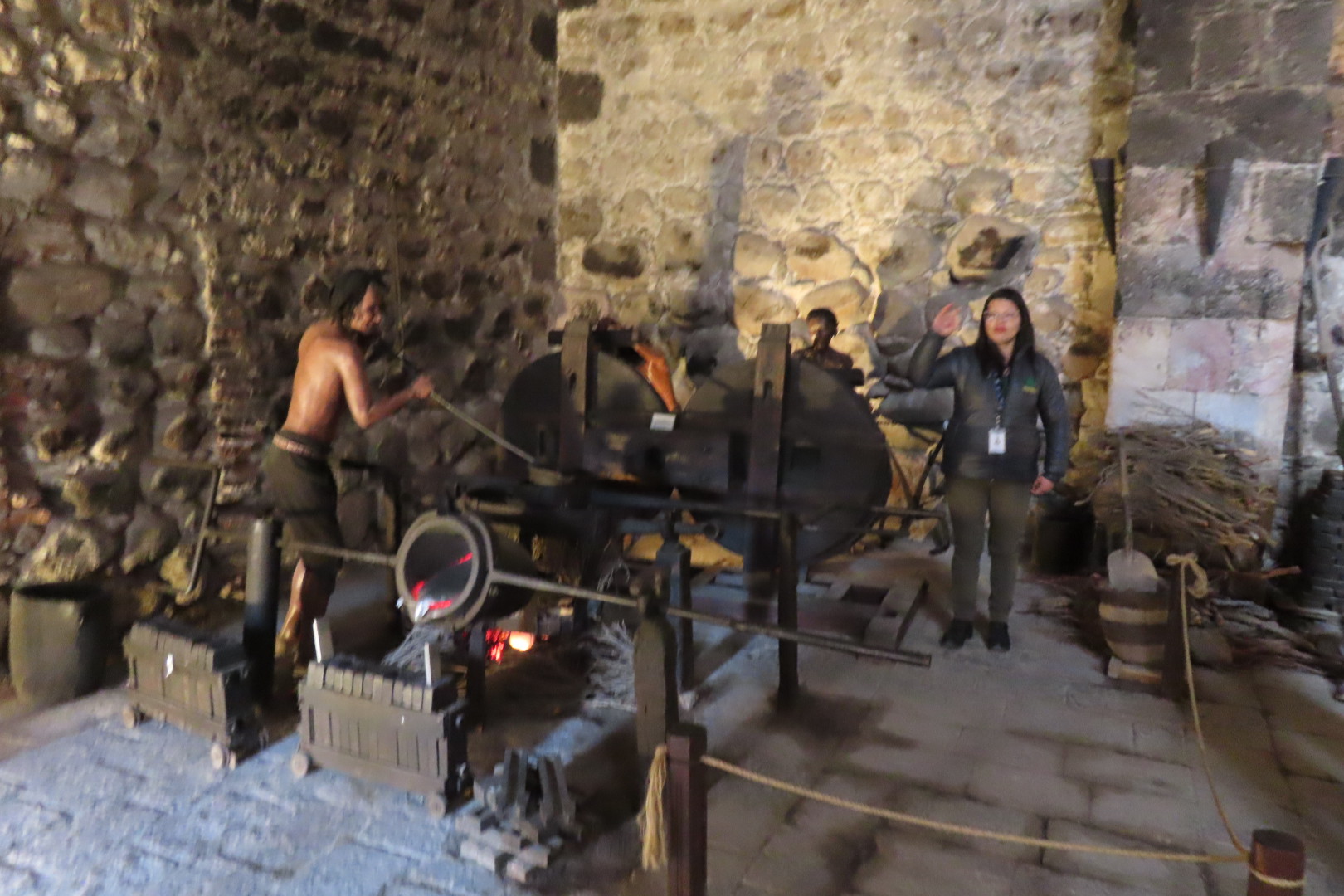
This used to be, in Spanish colonial times where the furnaces were located to process the ore to extract the silver. Each of those doorways was a furnace, I think there were 6 in all. One has been changed into a very nice chapel, another a room with all the minerals they extracted from Cerro Rico (Rich Hill)...

Finding dinner was a challenge, though we were happy with our choice of El Carcamo del gato even though we were the only people there, she was lovely. The cat is only there in spirit, I think!

But one is a mock up of what a furnace would have looked like. Here's where the horrors of silver production at that time were evident. The Spanish forced the indiginous people to work in the mines and in silver production. As the ore is mined, it is then crushed and the fine grains mixed with mercury and heated to about 1000 C. The mercury separates the silver from the rest and is poured out into moulds. Mercury is highly toxic so these people had a life expectancy of just over 30 years. Side effects were loss of hair, loss of teeth, mental disease, kidney failure, plus many others and eventual death!


Day 31 Friday

The mine tour, what everyone thinks they should do in Potosi. Cerro Rico is where the silver that made Bolivia rich before the Spanish took it all came from. It is said that enough silver has been taken from this mountain to build a bridge from here to Spain. It is still a working mine, producing silver, tin, lead and zinc, but tours seem to be the thing. We plumped for the mid option, that wasn’t all on one level so we knew we would have some crawling to do. It was just us at the tour agency at 08.45, so off we went with Ariel our guide. He seemed young but had worked the mine for 4 years. Not sure why he stopped. First stop was for over trousers, jackets, hard hats with headlamps and wellingtons, second stop was for shopping at the miners market, they can’t eat while down there as the dust would make food toxic, but they can chew coca leaves, drink pop and alcohol, which comes in two strengths, 40% and 96% proof! We bought coca, pop and 40% proof, a mask each, but we steered away from the dynamite and fuses that were also on offer! Third stop, the mine. In along the cart tracks, paddling through mud, lots of ducking under low beams that appeared to be mostly split through alongside pipes carrying compressed air for ventilation and drilling.

The tools used to make silver coins. In the early days each coin was made by hand by hitting a mould with a blank inside. Cerro Rico produced so much silver that, at one time, it bankrolled the entire Spanish economy, enabling it to fight wars, build the Spanish Armada etc. Nothing went into the local economy, it was all taken out of the country and the indiginous people paid the price. Money made here was legal tender around the world, even in China and it became the default world currency, rather like the US dollar is today

We could smell gas at various points, that made us cough, we were ducking to stop banging our heads and all in all, not having a very good time. But we were only visiting, we weren’t 14 and just illegally starting work, there till we made enough money, or died, which seems to be pretty much how it goes. As we went through we didn’t actually see any mining, but that’s ok, it was dusty enough without being at the work face, we did however meet guys pushing the carts that weigh 250kg empty and a tonne full. These people were the recipients of the stuff we’d bought in, along with tio, or the uncle of the mine who had to have his share of alcohol and coca as an offering to keep everyone safe.

One of three actual rooms where donkeys were used to turn these giant wheels. In the room above a mechanism drove rollers to squeeze the silver ingots thinner and thinner until it was the correct thickness to make coins. We could see the wear in the cobbles where the donkeys had worn a track in the stone. Apparently the life expectancy of a donkey in these conditions was 5 weeks!

It was smelly, filthy, claustrophobic, and generally unpleasant. Just a fortnight ago a couple of miners died being winched up as the winch cable broke. So why did we go? I have no idea, but we were very pleased when our two hours underground were over. And why do they do it? Well 800 bolivianos a month (about £92.50) as a waiter or 1500 bolivianos a fortnight (about £173.50) as a trainee miner. No contest I suppose!

This was upstairs where the turning wheel revolved these gears (no health and safety in those days - thank heavens our friend Bill - who reads this - wasn't around then!)

We’ve never felt so pleased to get back to a hotel room for a hot shower. Albeit a very strange hotel room. All the rooms face into a central courtyard, so all the windows are interior (except next door which doesn’t have any windows). This is weird enough but on the ground floor where we are the central courtyard is also a carpark. Three big jeeps can fit in, at a push, and do, with lots of noise and light! Our least favourite hotel so far it has to be said!

Eventually (I've got lots of photos showing the whole mechanism, but I won't bore you with them) two counter rotating dies, a certain width apart squeeze the ingot to a size, it's then passed to the next to make it thinner still and so on. All these gears were wooden, with knockout teeth in the gears for easy replacement when worn

A room displaying coins through the ages. Early coins were pure silver, but they were quite soft, so people used to break a small amount off each coin and save it to build up a quantity of silver that they could then sell. Later coins were an alloy which were harder to stop that occurring 

Our guide had sheets spelling out each letter of Potosi and when combined together it appears to show the 'S' with two vertical lines through that she says is the origin of the US dollar sign. Can you see it? I wonder if it's true, she claims it is. Whatever the truth, its a nice story

More 'modern' machinery used up until the 1970's to make coins. This used a steam engine in a separate room that drove the shaft high up in the room. Belts were taken down to power each machine. It's the same principle that powered all the textile mills 'up north' in the UK up until the early twentieth century. There's no guards round those belts, can you imagine what would have happened when one broke, as they must have done? Flailing belt fragments would have taken someone's head off. But for the colonial Spanish labour was cheap, just get someone else in to replace them! Don't look Bill!
 
A final picture from the museum and here two men swing round a lever which winds down a press to punch out a coin, the balls add a bit of force (inertia) to make the press force bigger. There's a hole behind in which sat a man who positioned each blank. Can you see his hands in the middle, placing a blank? What could possibly go wrong?

Always, walking through the city is Cerro Rico (Rich Hill) looming large. Just look at it now, it is just one huge spoil heap. It's now 300m lower than when the Spanish found it and it's riddled with tunnels. Quite why this hill contained so much silver when most other hills around are just rock, I haven't actually found a good answer for. Some say it's an extinct volcano, so all these minerals were brought up from deep within the earth, but others say it has never been proved that it was a volcano. For whatever the answer, it's the reason Potosi is here and it made the Spain of the 17th century fabulously rich, but has, and still is, causing untold human suffering 

Saw this old photo of Cerro Rico and, look, the hill goes up to a point. Not any more!

There are a huge number of tour operators offering mine tours. No mine tour is wholly safe, you take your chances going in there, but some take safety more than others. Its essential to make sure the guide is an ex miner and to make sure proper safety equipment is provided. We went to a tourist information office to ask their advice and we googled their suggestions and read a lot of reviews. This company, Koala Tours, seemed a good operator and had very good reviews so we went with them (they also operated the free walking tour we went on too). Next was to decide which one: the easy one was all on one level and had tunnels you could stand up in; the mid range one was this one, you go in at the higher level, drop down a shaft to a mid level, then go down to a lower level, exiting bottom left. A third option was crawling all the way. We went for the mid option

Here we are at the first stop, the gearing up room. All smiley at this stage

Second stop is the miners supply shop. You can buy everything related to mining in these stores. He's holding a stick of dynamite and on the table are a load more, along with fuses (2.5 minute 'run like hell' fuses), coca leaves and, the white bottles are 96% proof alcohol. Anyone over 7 could buy the dynamite, its 40Bob per stick (about £4:00)

Jackie holing a stick with a fuse attached

Driving up to our mine. Just look at these conditions and the destruction of that mountain. Its horrendous! But what's the alternative for people who were born here? That's where you'll earn most money, by their standards, no other job round these parts pays what you can earn here. But, as our guide told us, he earned 1500Bob per week, massively more than any other job. That's about £170 per week!

Here we are. He's pointing to the lower opening which is where we come out, we go in at the upper area in front and up

Approaching the entrance and a miner empties a truck of waste rock over the edge. I think he was 15 years old. Far in the distance you can see Potosi

At the entrance. Those trucks are on their side to allow full trucks free passage out. They weigh 250kg each and have to be righted and put onto the tracks. Not easy work! We were told that each full truck brought out earns 50Bob (£5). If two people do it that money is shared, so often young new people try to bring them out on their own. That's 1 tonne, slightly uphill on gritty tracks!

Before we go in we have to observe their Pachamama good luck rituals, which might involve spraying dead llama blood

In we go. The first parts easy, we're upright! The pipes on the right contain compressed air for the drills, not for ventilation. If you wanted some of the air for ventilation it costs 150Bob per minute! No one does, they have built odd vertical shafts to let in air. Incidentally, every miner has to buy all his own kit, nothing is provided

Now it starts to get interesting

At a full cart, our guide picks out a stone with silver glinting in it. Didn't come out well in the photo I know

There on the wall is a seam of silver. Look at the second torch beam down and follow that wavy line left and right. It glints amazingly in reality. The blue deposits above are, I think, copper sulphate

That is a llama skin bag, used in colonial times to carry out the ore

This, I think, really shows the dangers down here. Look at that horizontal pit prop. Its actually broken (one of many we saw), with the massive weight of rocks above. Occasionally teams would come down to replace these. How do they do it, I asked. He said someone would poke the rocks with a stick or hammer and chisel to remove them to relive the stress of the wood before replacing, allowing it to be replaced. No danger there then!

Down the first steeply sloping shaft

It was very much a crawl on our backs. This was one of the better positions, I couldn't get my camera out on some of the tighter bits. We went feet first and it was a case of elbows down, lift back and move forward with head back to slowly move along

They've gone down there somewhere, I'd better try and catch up

4 miners who didn't mind having their photo take. Not sure of their age, but they were chewing coca leaves

More Pachamama rituals. This was one of 5 'uncles' and we had to sprinkle some coca leaves on his head, then his shoulders, hands, his penis and at his feet. Then alcohol was sprinkled on each of those places. The head was for mental stability down here, shoulders as he has to hold up the roof, hands as these have to do all the work, penis for fertility and feet for Pachamama

On the last stretch now and daylight can't come too soon

And after 2 hours underground we emerged into daylight, which seemed really bright

A look back at that mountain that has shaped so much history in the last 400 years for Spain and South America

And there she is, Miss Style 2024! That's it from Potosi, the highest city in the world. We've had a relaxing afternoon, writing this blog, we went out and bought Jackie a holiday ring of Bolivianite stone and Cerro Rico silver, very apt and had a lovely meal and a glass of wine at El Tenedor de Plata. For the last three days in Potosi we've been at over 4000m and, apart from a tightness in the heads on the first day, we've both since been perfectly OK. Sure, we get a little out of breath on occasions, but it seems we've finally acclimatised! On even higher to Uyuni and the Bolivian Salt Flats!


Wednesday, 20 November 2024

South America, Days 26 to 28 - Stage 6: La Paz to Sucre, Bolivia

In San Pedro Plaza with Crazy Dave. Check out the YouTube video below of his presentation (if it uploads in time)

Day 26 Sunday 

We did both enjoy our curry last night, though neither of us could finish. We didn't however enjoy the pouring rain all the way home.

What to do with ourselves today? We have a one hour flight at 19.30 (rather than the 12 hour overnight bus journey, which would have been half the price, but you arrive feeling rubbish, probably unable to get in to your room....it's what we would have done last time, but how times have changed!)


I'd reserved this place to put the YouTube video I've

put together of Crazy Dave, but it's taking so long to upload on the wifi 

here that I've given up. 17% upload after 3 hours! I'll add it to the next blog

it'll be well worth watching!


We don't have to check out till midday, but he posted the blog last night so we might as well go out. Google maps says the Mamani Mamani art museum is closed, which is a real shame, but that the Murillo museum was open till 13.00. we retraced the route we'd done with Johnny, but how different it was on a Sunday, so quiet. Surprisingly the art gallery was open which we were both pleased about, we both really loved the colours, but couldn't even contemplate buying at this point. The Murillo museum however wasn't! We drifted around for a bit, found a market and an iced coffee before heading to San Pedro Plaza for 13.00. This is the time that Johnny said Crazy Dave does his presentation.

The notorious San Pedro prison, La Paz with queues of women waiting to go inside

Crazy Dave is an ex NY coke head. Lives on the street apparently (though unlike his slightly irritating friend, he didn't actually smell) and would be identifiable by being dressed all in green. We were a few minutes early so we sat on a bench watching the women queuing to get into the prison, and the policemen just milling about in the square. He was easily identifiable, and just as I pointed him out to Brian he approached us to ask if we were here for the presentation?

Side entrance to the 'private wing' of San Pedro prison with queues of women waiting to go inside to be with their husbands

He talked for an hour, to us and at least another 5 people, going off on tangents and being right in your face. He didn't mind photos or being videoed though whether Brian can manage to edit anything down today remains to be seen. We got a potted life story, basically coming down to how he ended up being arrested in Bolivia for trying to smuggle out 2 bottles of cocaine liquid and put into San Pedro for 14 years. His first year was hell, the second easy when the bosses realised he could help their kids with English, paying him 6g of cocaine a day. He then went to work in the cocaine factory before becoming one of the prison tour guides!

Cheers from The English Pub, La Paz

He seemed like a nice guy, didn't feel threatening, was very funny and has been doing this talk for tips for at least 7 years. He's well overstayed his time in Bolivia, but can't go back to the USA as the alimony he owes his ex wife (whose affair with his drug supplier produced the 3rd baby, that tipped him over the edge) is more money than he can ever hope to lay his hands on. Intelligent and well practiced the presentation was an hour, almost to the minute, that we all enjoyed spending with him.

Our small local plane to take us from La Paz to Sucre

A late lunch at the English bar, fish and chips for B and sausage and mash for me, with the end of the England v Ireland football game and we went back to the hotel to wait for our airport taxi.

It was early, so we were early, couldn't check in, but they did eventually let us. All very laid back. As we went through for boarding, down some stairs and out onto the tarmac, there didn't appear to be a plane, but there's was, a tiny jet, but that's ok. It took off early, I guess all passengers were onboard and for some reason did the whole flight in the dark, apart from checking we were all buckled up before coming in to land! Unsurprisingly we landed early too, our bags were through promptly but how great, there was our taxi driver with a sign with our name on.

Lovely Sucre. The centre of town is beautifully kept with these fabulous white buildings. This one is the Autonomous Departmental Government of Chuquisaca  building

We were out of the airport before we should even have landed and off for half an hour to our hotel in Sucre.

View from the plaza. Its the government building on the right and the tower of the cathedral on the left


Day 27 Monday 

A slightly late start, but we hadn't got anything planned for Sucre, the official capital of Bolivia, just to wander around and look at the attractive white colonial buildings. We walked to the park and went up the Eiffel tower and basically drifted with a vengeance finally finishing up with a rooftop visit to the San Felipe Nero convent, now a school, but used to be a monastery ( no I don't know how a convent used to be a monastery either). The prime reason for visiting was to go to the roof and look out over the city. Well worth it. See our Relive video with photos: click here

This is still on the plaza but at 90 degrees and, this building is the Casa de la Libertad, a very important building not only in the history of Bolivia, but of all of South America for it was here that the declaration of independence from Spain was signed on 6th August 1825. It was signed by none other than Simon Bolivar and Mariscal Antonio Jose de Sucre, after whom the city was named 

In between drifting we had been in communication with a cruise company in the UK offering what seemed like a great deal on a trip from San Antonio (close to Santiago in Chile) round, the bottom, passing Antarctica, The Falkland Islands finishing up in Buenos Aires. For 22 days in February. I think we have a cabin but the promotion seems to have taken everyone by surprise!

We went in, well, we had to, this is history before us and this is Simon Bolivar, recognised as the liberator of South America from Spain


Day 28 Tuesday 

We both woke up a little late, but we'd neither slept well. Very hot, despite the thunderstorm outside. 

And here is the declaration of independence document. Like the American declaration of independence it was signed before freedom was obtained, it was a declaration of intent. Many more years of fighting the Spanish were ahead of them

We had been contemplating a taxi to Potosi, our next destination, tomorrow, but what our lady at the hotel said it should cost compared to what the taxi company who brought us from the airport quoted, we've decided to get the bus. We yomped to the bus station to buy tickets for tomorrow as time was a bit tight but the process seems to have been quite easy. £3 for 3-4 hour bus journey tomorrow as opposed to somewhere between £24 and £38 for a taxi!

This room was covered by the past presidents of Bolivia and I included this photo as, top left is Juan Moralis, the ex president and prospective president for next years election that we wrote about in our last post

We got back in time to pick up the Dino bus which took us out to the local cement factory. In 1994 while mining limestone one of the largest collections of fossilized dinosaur footprints in the world was found on a vertical wall. According to Wikipedia there are a total of 12,092 individual dinosaur tracks in 465 trackways. Nine different morphotypes of dinosaur tracks have been documented, including several trackways of theropods, ornithopods, ankylosaurs, and sauropods, with the latter group accounting for 26% of the trackways.

This is Independence Hall, the seat of the government of Bolivia until 1898  

It was an amazing site, albeit on a vertical wall rather than a lake bed, perhaps this made it easier to see. A few years ago a section fell down, only to expose more footprints underneath, fortunately it's not on good limestone so the quarry doesn't mind the visitors and guided tours. Their opinion might be different if they actually wanted to use the material.

From the top of the room looking back is this fabulous balcony

Back to the room, I've written and Brian is looking at video clips of Crazy Dave. It could take a while for the blog to be published. 

This is the actual flag of General Manuel Belgrano (anyone remember the ship General Belgrano that was sunk by the British in the Falklands War?). He was commander of the Army of the North and it was used to swear in his troops. This ensign fluttered victoriously at the Battle of Salta on 20th February 1813 and as the army climbed to Alto Peru. They were defeated there and the flag was hidden in a church near Potosi as they retreated. It was found accidentally 72 years later in 1885 hidden in an altar 

Tomorrow we go to Potosi so after 3 nights at a couple of hundred metres lower than we had been, tomorrow we go to just over 4000m!

It was a thoroughly enjoyable visit and we took in a lot of history over a couple of hours, so it was time for refreshments!

As we came out there was some sort of protest going on in the plaza. It seemed pretty peaceful so I risked taking a photo. No idea what it was all about, but they'd marched halfway round the plaza chanting something

Just a short walk away was Simon Bolivar Park and this was the entrance

A small park but quite pleasant. It even had a miniature Eiffel Tower in the middle, a creation of the famous Gustav Eiffel himself apparently

It had a little spiral staircase so it had to be climbed! Here we are at the top, it wobbled a little!

Don't look down! Oh, too late

Walking back and working up an appetite for dinner we went into the San Felipe Nero Convent and climbed up to the roof. What a lovely building!

Looking over the rooftops of Sucre to the hills beyond

Exploring the roof of the convent

On the left is the end of the convent and the white wall to the right is a separate building with a big drop between. We both said that, if this was a James Bond movie he would be leaping from one to the other chased by a criminal. It looked very doable!

Over there is, on the left, the government building and, on the right the bell tower of the cathedral, our next destination

And here we are in the cathedral. Very nice place

Todays visit was to the nearby dinosaur footprints rock face. Its in a working limestone quarry where they are making Portland Cement and, on this face in 1994 they uncovered a whole slab containing the worlds largest collection of dinosaur footprints  

They are quite impressive from a distance, but recently a new path has been opened to allow us to get right up to them, but only with a guide

Amazing you can see how the mud (as it was then) deformed under their weight 

You can see  how the animal wandered along what was then a flat beach  or shallow lake. It's been tilted to near vertical by the movement of the Pacific plate under the Atlantic plate that raised the Andes mountain chain

Jackie giving an indication of the size of the footprints

The print of a three toed something or other

It'll be one of those, I'll let you decide

There was quite a nice museum attached. Here's a cast of a print they found 

Along with some life size models. This one is the largest dinosaur

And just to prove how big it was, there's Jackie walking underneath it

And there's the Loch Ness Monster (with a pair of sunglasses on a flipper!)