Saturday, 23 May 2015

A walk through Warwickshire villages


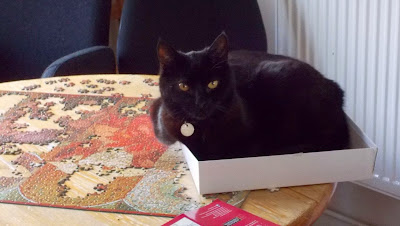
Maggy cat still unhappy when our attention is on a jigsaw!

Three counties in three days! From Solihull in the county of West Midlands (it used to be in Warwickshire until boundary changes in the 1970’s created the West Midlands), our home village of Alvechurch in Worcestershire on Thursday and a three church (and three village) walk through Warwickshire on Friday.
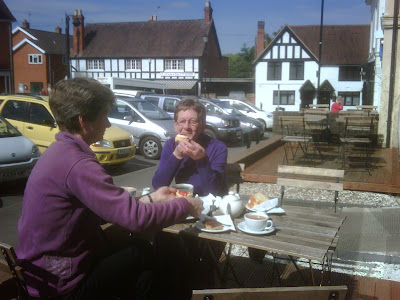


Afternoon tea and cake with Pauline in Alvechurch
We returned to our home village of Alvechurch (population in 2011 census: 6564) on Thursday, not to look at our houses, in fact we didn’t even pass them, but to visit Pauline, Jackie’s mum, who also lives in the village, and to undertake a day of much needed gardening.

She has an ‘unconventional’ garden: areas of gravel, stones, shells and plants that might be considered weeds by some, an interesting stone path winding round bushes and overhanging trees, to a hidden top section of plants, trees  and a small fenced patio area with a table and chairs. It’s grown and now needs taming, so we tackled it with loppers, shears and forks and made progress, oops, was that a plant I just put that bag of gravel on? Looked like a weed to me, but what do I know!
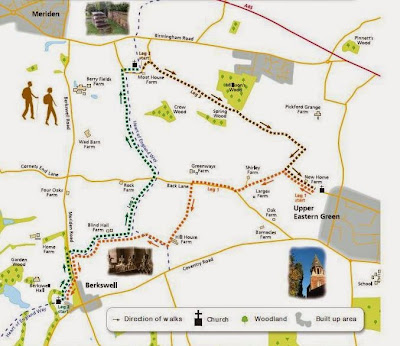
Our three churches walk from Meriden
No ‘before and after’ photos though, we were just too busy working and creating stuff and the result was good. It was pleasantly followed by tea and cakes sitting outside in the sun at the new posh café in the village square (I say ‘new’, it’s been open 9 months now apparently, but it wasn’t there when we left in July last year), an amble back in the warm afternoon sunshine, some baking, Jackie cooking a fabulous but cholesterol on a plate tartiflet and then home to a disgruntled Maggy cat who had been left on her own all day!
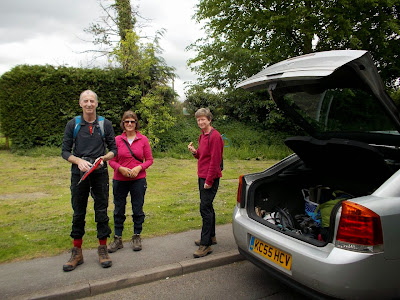


Walking boots on and ready for our walk
Friday was no better for her as we were out again for the day, this time for a walk with Brian’s sister Denise and husband Paul. The weather was still warm, not so sunny but still pleasant and we decided on a ‘three church’ 7 mile walk in the central England county of Warwickshire. The three churches are St Laurence in Meriden, St Andrews, in Eastern Green and the fabulous St. John the Baptist in Berkswell.
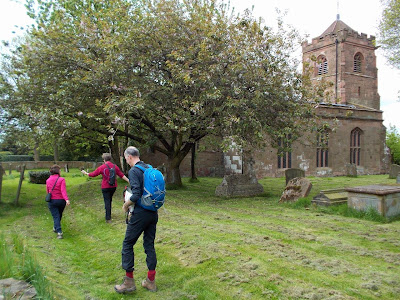


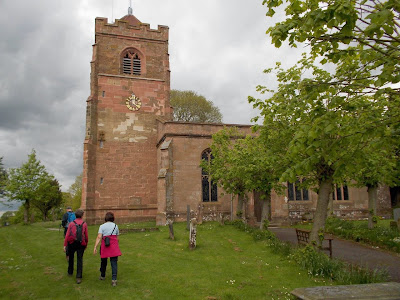
Arriving at St Laurence church, Meriden
The start was from outside the Queens Head pub in Meriden, a town that is generally regarded as being in the very centre of England and has a sandstone monument on the village green with a plaque referring to this traditional understanding. It was home to the Triumph motorcycle factory from 1941, after the Luftwaffe bombed the original factory in Coventry, about 6 miles away, until it closed in 1983. The old factory is now a housing estate with road names referring to old triumph motorcycles.
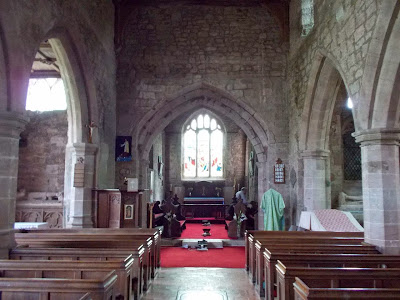

Inside St Laurence church
Just a short walk away is the partly Norman church of St Laurence , with sections built in the 12th century and other sections built up to the 15th century. It is only open on Sundays, but as we arrived there a warden was just opening it up and we were able to go inside and take a look. It apparently was built on the site of an earlier Saxon church built by Lady Godiva, of Coventry fame, who at that time owned the land.
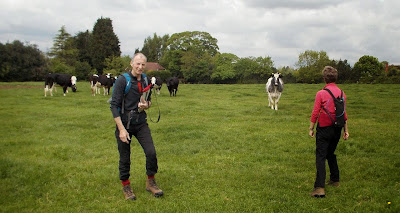


The cows strode towards us, but one look from Jackie stopped it dead!
Onwards across fields, ably navigated by Paul, past woods and through fields of cows, who strode towards us and intimidated us, probably following the recent report of former SMC member Richard Lloyd who has been trampled by a herd of cows while out walking his dog nearby, eventually arriving at the Victorian St Andrews church in Eastern Green on the outskirts of Coventry. Lunch stop here in the graveyard, watching some dark grey clouds hover overhead, but thankfully not releasing any rain and then on to the fabulous St John the Baptist church in Berkswell.
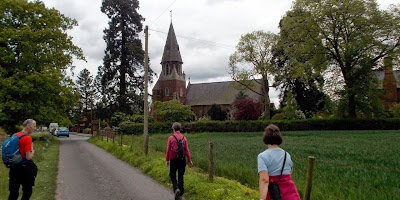
Arriving at St Andrews, Eastern Green
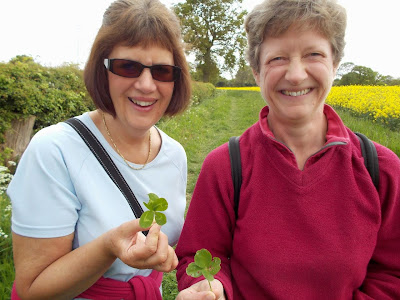
On the way to Berkswell, walking round the edge of a field of Rapeseed, Jackie bent down and came up with a four leaf clover. People not from the UK will probably not know the significance of this, the clover is a perennial short-lived plant (or weed!), very common in the UK, but most commonly having three leaves and only occasionally four leaves. 

Inside St Andrews
Denise and Jackie with their four leaf clovers
To find one is considered to be very lucky, so that’s the time to go and buy a lottery ticket! This caused us all to start looking at the wild grasses  at our feet that contained large amounts of clover growing in amongst and, in a short while eagle-eyed Jackie picked another one, closely followed by Denise, how amazing is that! The problem is that once picked they wilt very quickly, but we have photographic evidence! Not to be outdone I carried on looking and found one myself – however, I didn’t pick mine, just took a photo. ‘This is why four leaf clovers are rare’ I said, ‘because people always pick them, making them even rarer, but not me’ he said polishing his halo!

And here's mine, still growing in the ground!
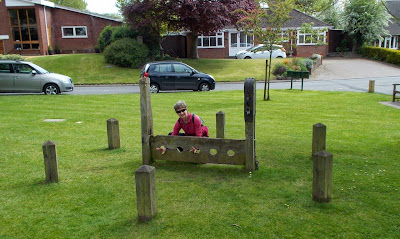
The stocks at Berkswell
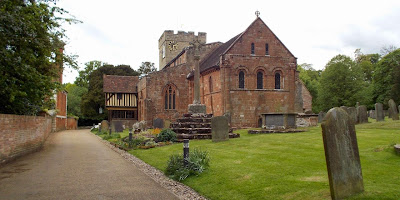
Bit of a posh place Berkswell, nice village green with a set of stocks in the middle with five holes in it! Why five holes? Apparently it is claimed they were specially built for a one-legged ex-soldier and his two drinking companions. Anyway the church is a gem, another Norman church, but with parts, notably parts of the crypt and some steps outside, from a much earlier period, maybe 725AD. A porch at the entrance to the church is Tudor and was built in the 16th century, when the church was already 400 years old. It looks oddly out of place, but as it’s been there for five hundred years and is much older than many other buildings it can’t really be described as modern!
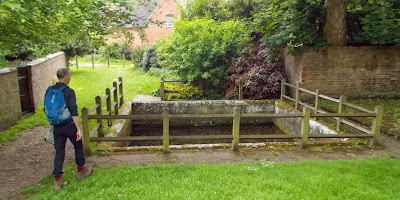
The well at Berkswell
The fabulous St John the Baptist church with tudor porch extension
Denise and Paul used to know the rector of the church and remembered them to be quite well-to-do and the whole town exudes this feeling, well-kept old buildings and well-tended gardens and lawns, a very pleasant place to visit. We probably brought the tone down by sitting outside the church drinking coffee from a flask, but do we care?
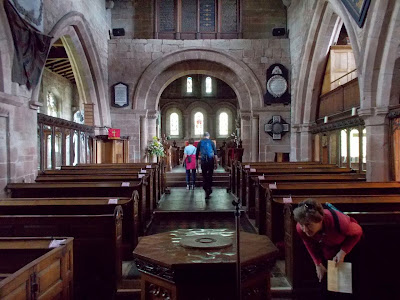

Inside St John the Baptist church. Jackie is crouching down having found one of the carved wooden mice on the font
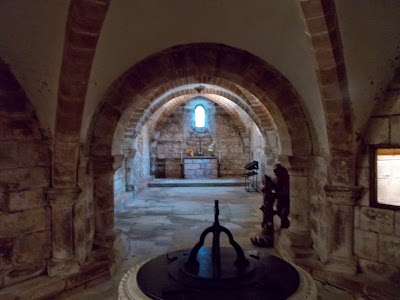
Down in the crypt
Inside the church is equally as spectacular and beautifully kept. Jackie followed a guide to try to find the nine carved mice in the woodwork, she found six, while D&P ambled round. Brian found the entrance to the crypt, which was open to the public so we went down and found a fabulous, very old with sections even older but again very well preserved, room. A great visit and well worth the visit. Just outside the grounds of the church is the old well that, it is believed, gave its name to the town, Berkswell (don’t know who Berk was!).
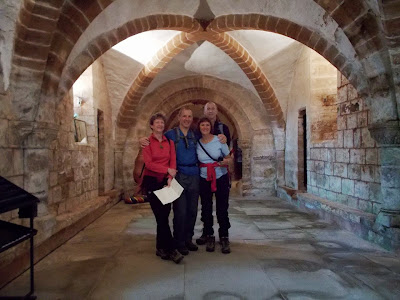
In the crypt. We got the ghost to take this one!
We were back in time for an afternoon pint of real ale at the Bulls Head in Meriden, then back to D&P’s for dinner, walking in to the fabulous smell of her casserole cooking in the oven, followed by Paulines apple and blackberry crumble and custard that we didn’t eat the day before and a nice bottle of red wine.

It’s a tough old life! Park Run today for Brian, 24 min 31 sec for 5km – how good is that!
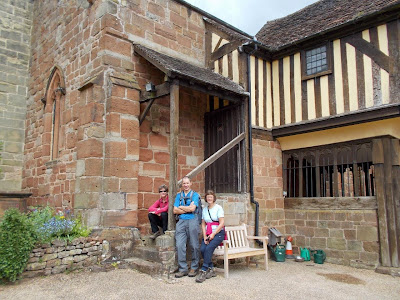


Jackie, Brian and Denise looking cool outside the church. What do you think of that Tudor porch on the Norman church? What was the planning department of the 16th century thinking of!

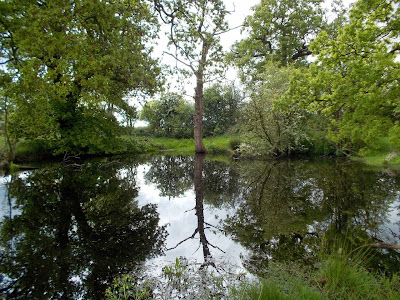
A pond near Meriden

Arriving back at St Laurence in Meriden. Yes its 4:00pm - beer 'o' clock!

7.5 mile walk, I think we deserved it!

Wednesday, 20 May 2015

A day out in Coventry


Coventry, 19 miles east of Birmingham and home to 330,000 people is generally dismissed as an uninteresting city on the eastern edge of West Midlands County, yet it has much more to offer and has great place in history and our day there as tourists was not enough. It’s the city I worked in for 23 years, but visiting as a tourist made me realise how little I knew and we thoroughly enjoyed our day visit on Jackie’s birthday. 

The 14th century St John The Baptist Church by Spon Street, Coventry
Most people are aware that the city was virtually destroyed by the German Luftwaffe on 14th November 1940 in an effort to disrupt or destroy the country’s armaments factories. Coventry had many factories producing military vehicles, munitions and aircraft parts, but they were scattered across the city and the decision was taken to blitz the city with incendiary bombs to flatten and burn the city and cause the maximum disruption. Few buildings remained standing and the rebuilding in the 1960’s was during a period of ‘functional architecture’ and the city is now blessed with more than its fair share of these uninteresting buildings, further isolated by its raised inner ring road of concrete.

Medieval Spon Street (with a very big black cloud in the sky!)
It was a tragedy as Coventry has a rich history of which precious little now remains. It was founded in Saxon times, possibly named Coffantree and had a Benedictine monastery founded by the Earl of Leofric and his wife Lady Godiva in 1043. The legend of Lady Godiva riding naked through the city on horseback in an effort to persuade her husband to lower taxes on the poor people still survives today and the city makes the most of this uncertain, dubious tale.

Statue of Lady Godiva riding naked through the city
The city is mentioned in the Domesday Book of 1086 as having 350 residents and, in 12th century had its own castle that is sadly no longer in existence. In the 14th century the city was divided into two halves, the Priors half and the Earls half, each having its own church, both still in existence today, standing less than 100m apart in the city centre, at that time fortified by city walls.
Coventry became a city by royal charter in 1345 and, in 1456 actually became the seat of government, when Queen Margaret moved the Royal Court to St Marys Guildhall, a building still standing today.

The historic centre. Guildhall on the right, ruined cathedral on the left
The city walls were all but destroyed by Charles II, the monastery was dissolved by Henry VIII and was eventually dismantled and the cathedral was all but destroyed in 1940 by German bombing. But despite all this a number of historic buildings remain and it’s these that we found on our day visit.
Medieval Spon Street was our first stop and this is a superb example of original buildings still standing, but it is not all it seems, the buildings are genuine, but most were not always here. The buildings here that survived the bombing were restored, but the street now comprises many historic buildings from other parts of the city that were moved here to create a medieval street and it is now a conservation area, containing shops, restaurants and pubs.

Inside the old bombed cathedral showing the canopy to the new
Set back from the main street is the Watchmakers Museum in an original building, containing relics from the city’s watchmaking past and we spent an interesting hour or so in this small building, partly because it was interesting but also to escape a very heavy shower of hail and rain that hammered down from the inky black cloud that passed regularly overhead at frequent intervals! It’s cold and it’s wet, not like normal May weather.

The rain abated, we left Spon Street and headed off through shopping complex in the centre for lunch, shoe shopping for Jackie and then through to the very old section around the old Coventry Cathedral, the Guildhall and the Priory church. It’s a fabulous medieval area, beautifully restored, with the ruins of the old cathedral as its centrepiece.

Inside the old cathedral looking down to the tower. The spire to the right is the Prior church, in a separate half of the city in medieval times
Inside the Great Hall of the Guildhall, the Coventry Tapestry is under the window
Whoever says there is nothing old to see in Coventry should come here, the Guildhall, although damaged in the bombing, has been beautifully restored and contains some priceless relics. In the Great Hall hangs the Coventry Tapestry, one of the rarest tapestries in the country, manufactured around 1495 and 1500 and still hanging in the place it was originally designed for. Also in the building is the Mary Queen of Scots room and believed to be the room the Queen was held in on the orders of Queen Elizabeth I. It’s old, it’s full of treasures and it is so worth a visit, it’s also free to enter!

View from the other end of the Great Hall
The old bombed cathedral has only its walls and tower still standing, the roof burned through and collapsed in 1940 and it was decided to leave it as a reminder of those days and build a new modern cathedral at right angles to give the impression of the new growing from the old. We took a guided tour of both old and new cathedrals which was both interesting and bizarre. The cathedrals are Church of England, protestant, our lady guide was a catholic German lady and our fellow tourists were Quakers, so the conversation of the overlap between the three religions was quite interesting and I think we both learned quite a bit!

Inside the new cathedral showing the largest tapestry in the world
The new cathedral was finished in 1962 and is of modern architecture and is exquisitely designed and really brings the old and new together in a very emotional way and incorporates some really interesting features. Behind the altar is the largest tapestry in the world, measuring 22m x 12m which had to be made in France in the only facility capable of producing it. The organ has over 4000 pipes and the cathedral is capable of seating over 1600 worshipers. It is immense, modern and beautifully designed with many amazing features and is well worth a visit.

The great window and entrance with a view to the old cathedral
The floor of the old cathedral is much higher than it was as it now covers the old roof ruins, presumably to protect them for future generations and the old window openings still contain some of the old stained glass remnants. Most of the stained glass windows were removed as the bombing of the city was anticipated, but although they are still in existence, they now have no home to go to, so some are on display in the new cathedral. Displayed inside the new cathedral is a wooden cross of burnt roof timbers that apparently had fallen into the shape of a cross after the bombing. Someone taped them together and put it on display. Old medieval nails were collected from the rubble, strung together into a cross and presented to a church in Germany. It has since become a symbol of unity with copies now in over 170 churches throughout Europe.


A closer view of the tapestry, altar and organ pipes
The intermittent heavy rain showers continued between sunny intervals and, by the time we had finished we had to hurry back to the car, abandoning plans to visit the historic car museum (Coventry is home to the first car built by the Daimler car company and subsequently became home to many car manufactures such as Humber, Hillman, Singer and Triumph to name but a few).

We finished our day in Solihull, walking round the corner from Helen and Phil’s house to an Indian Balti restaurant for an excellent curry and beer. I think Jackie had a great birthday, it was a really interesting day, it just shows what there is to see in a city that doesn’t normally feature on a tourist itinerary.