Tuesday, 13 December 2022

Our USA Adventure - Days 75 to 78 - Palm Springs, Tecopa, Death Valley, Beatty & Rhyolite

Artist's Palette in Death Valley

Only a couple of days since the last blog, and possibly not much to say, BUT lots of pictures, if he can work out how to make them look like what we saw.

A long drive for us from Palm Springs, just over 4 hours got us to Tecopa, a tiny little place, Delight's Hot Spring Resort, but about all that was left on Bookings.com

Delight's Hot Spring Resort where you can swim in naturally heated spring waters of 40 C even when it's cool and windy

It wouldn’t have been our first choice, no WiFi, no showers in the room and once booked a note that said bring lots of drinking water and a full fuel tank. So we stopped at Baker for a bite of lunch and to fill with fuel. We also took the opportunity to look at the world’s largest thermometer and the Alien Jerky store. No, we don’t know why either! We then headed north, through desert, for what seemed like hours. This was not setting Death Valley, a big desert, up well but it was too late now. After lots of miles of nothing, as we approached our destination some very pretty striped, multicoloured mountains hove into view. OK, this might not be so bad. We checked in and having had a nose around decided we would go in the open air pool, despite the really cold wind. We didn’t fancy the private baths, though they were infinitely better than the ones we’d seen, right at the beginning of the trip, in Truth or Consequences. 

Or in your own indoor pool - just like the Roman's used to do

The main pool was 101 degrees, with the little satellite pools being 104 degrees, obviously this is Fahrenheit, but translates as 38 and 40 degrees centigrade. We lounged around in the hot mineral pools with an amazing view of the mountains till the sun set. The showers in the private bathhouses were the same temperature and mineral content, but without the chlorine that they add to the pools, so we could shower, before walking to the brewery and BBQ house at the end of the property! Bev and Iain, you’d love it! Oh, and there was WiFi, it claimed to be only in the lobby but it made it into our bedroom, though admittedly it wasn’t the best, it was good enough for us. We were glad we’d heeded the note about bringing water though as the only water they have is the hot mineral spring water. It’s very weird when you touch the toilet cistern and find it hot!

Heading to Death Valley in rain and overcast skies. Extreme heat is not going to be a problem today  

Woke the next morning to pictures of snow in the U.K., looked out to what looked like snow with us, that was salt on the ground, but the mist wasn’t what were expecting. Not sure what to expect we headed towards Death Valley, driving through rain, which certainly wasn’t what we were expecting. As we drove a little bit further the rain stopped, though the temperature was still in single figures, the mist cleared and the scenery just blew us away. We did not expect the colours in the rocks, orange and grey maybe, but black and white, lilac and green? Wow.

On the way, after it had stopped raining, Jackie spotted this Red Tailed Hawk on a rock. 'Stop' she said, 'reverse back' and there it was. This is at full zoom on my camera so not that sharp, but isn't he fabulous

We met a lad who told us we had come in the ‘quiet way’ which was certainly true. He recommended a couple of stops, which added to the recommendations we’d got from a lovely group of people at the oasis in PS led to a full day out. Badwater basin, The Devils golf course, the Artists Pallet, Golden Canyon, will all be so much better in the pictures than I could describe. We weren’t doing too badly until I put Dante’s viewpoint into the sat nav and discovered that was adding an hour and a half to our day, but it had to be done. In theory from there, we would be able to see across Bad Water, one of the lowest places on earth 282’ below sea level, with a sign way up on the cliffs marking where sea level is, to Mount Whitney, the highest place in the contiguous USA. This was accorded to the book, though no mention was made on the signs, a lady today said you can definitely see Mt Whitney from the park, if you know where you are looking! It was freezing, about 4 degrees centigrade and very windy, so we jogged to the viewpoint. It was so worth it though. We even got to see sunset on the rocks as we drove out to Beatty in Nevada our stop for the night, the Exchange Club Motel.

I went to take another photo just as he decided to fly off and I just happened to catch him. I know it's not very clear, but he hasn't raised his legs yet and look at the size of his wings. Fabulous bird

We had only been planning one night in Beatty, but hadn’t managed to see any of its sights, so we immediately booked another night. Although it is a small town, it is very close to the ghost town of Rhyolite which was well worth exploring. Rhyolite promised so much, it was founded in 1905 when gold was found in Bullfrog Mining District. Two years later there were between 8000 and 10000 residents, not just living in tents, but three story buildings, indoor plumbing and electricity, an opera house, churches, banks, schools, a stock exchange and 3 railways. However when in 1911 the most profitable mine, which had only made $2 million, closed the town went bust. Some buildings were moved, and some have just vanished completely. The railroad station they are trying to preserve, but you sort of have to wonder why.

We took photo after photo as the rocks are such vivid colours, so I'm going to have to be really selective on which one's I put on

To get to the buildings you have to pass the Goldwell Open Air Museum, more an art installation which began with “The Last Supper” by Belgian Albert Szukalski. Live models were wrapped in fabric soaked in wet plaster and posed. Once the plaster had set the models could slip out. The rigid shroud was the. Coated in fibreglass making it weatherproof. There are other pieces here, but that is the most impressive.

Jackie just picked these few stones up off the ground to show what  varied colours they are

We stopped by the museum on our way back in to town, very eclectic, but full of information. We were given information on how to get to the mud mound , where fossils abound apparently. We set off, along a dirt track, in very good condition as there is a lot of surveying going on so big trucks and lorries did keep appearing driving very fast. We wimped out however when we hit the snow line, and it was apparent that this wasn’t part of the well maintained road, and anyway who wants to look for fossils under the snow? So here we are, another blog, and I might even book our last 4 nights accommodation so it’ll be done!

Our first proper stop was at Badwater Basin. You can see there's a short boardwalk and then a long trek over salt plains to a broad expanse of salt about 1km out. As you can see, it's 282 feet (85.5m) below sea level and a mark on the rocks shows where the sea level would be. It's not, however the lowest point of dry land on earth, that belongs to the Dead Sea in the Middle East which is a whopping 1360 feet (414m) below sea level

This was out on the broad salt flat. By this time is was about 21 C but a very strong wind, as you can see from the angle we're standing. It was a weird sensation walking on this as it looked just like snow and ice, which is very slippery. Salt flats on the other hand are quite grippy, so your mind was telling you one thing, but feet told you something else

The Devil's Golf Course, another 13 miles further on is crystallised salt in jagged formations that could do you serious damage if you fell on them. The ground is very uneven and they are very hard and sharp edged. The area it occupies is immense, it covers most of the salt flats. The  whole valley is about 140 miles long and between 5 and 15 miles wide

Driving towards Artist's Palette from the Devils Golf Course the scenery is stunning. Photos can never capture the real beauty, but hopefully these photos give some idea of just how fabulous this place is

The Artist's Palette drive is a 9 mile loop with lots of stopping off point and it is absolutely not to be missed. Now I know these photos haven't really captured it, you're just going to have to visit yourself to have the colours all around you

From this higher pint we could see out to the salt flats beyond

This was another stopping off point, the same place the first photo was taken from. We're standing on a lilac rock and there's green, yellow, red and black rocks around us

Our next stop, about 42 miles from entering Death Valley was here at Golden Canyon. We just did a mile hike up to a junction then turned round and came back, as time was already getting on. There are many hikes from here, some up to high points, it's also possible to do a circular 4.3 mile hike. Incidentally, we were told that some scenes from the first Star Wars film were shot here and, apparently, it's not unknown for people to turn up dressed as Star Wars characters. I did a short Relive video of our walk through the canyon, it has a lot more photos on than those posted here. You can view it by clicking here

This was as far as we got. Red Cathedral is straight on, to the right is the circular hike

On our return leg in Golden Canyon

We then had a 26 mile drive out of Death Valley and then back in to Dante's Viewpoint high over the valley. It was a long drive but very worthwhile. The wind was still very strong and, being high, the temperature much lower. it was about 4 C at the top! We didn't stay that long, but look at this jaw dropping view! 

There were other people up there too, so we got them to take a photos of us in exchange for us taking one of them

Today's visit was to Rhyolite, a crumbling ghost town and this is the outdoor sculptures placed there. We did a short Relive video with more photos. You can see it by clicking here

A bit more of the outdoor sculptures before we went on to the ruined town proper

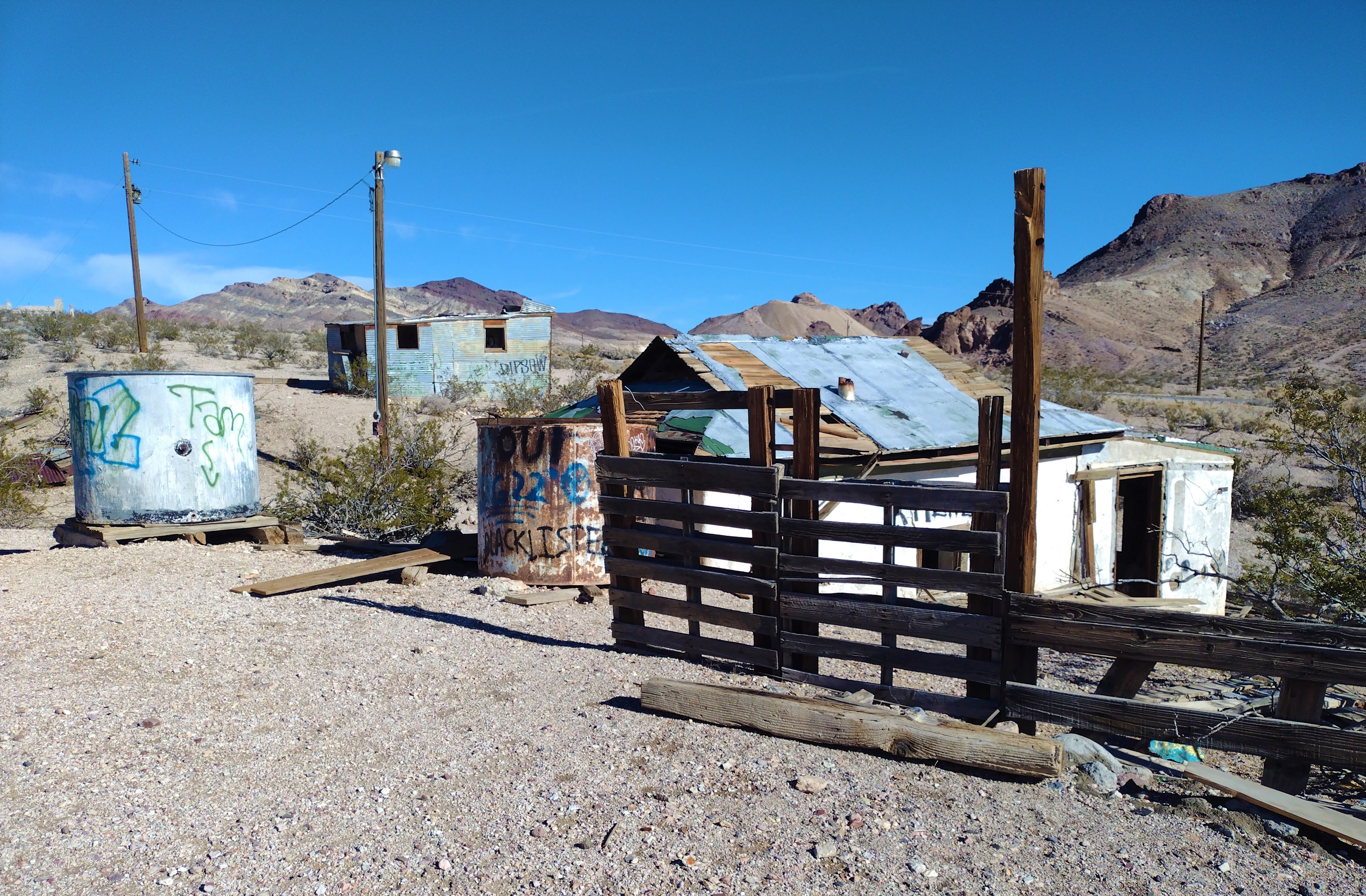
The first ruined shack and an old abandoned vehicle. Behind is Bazooka Mountain and you can see some of the old mine workings. Apparently you can go and explore them, but we didn't. We did meet a gung-ho chap about 40 years old who was taking two younger people on a mine tour. He hadn't explored them before and we just felt a bit worried for them. We told them to take care in old mines, they can be dangerous. He smiled, thanked us and set off energetically with his two youngsters trailing behind

More ruined buildings

Tom Kelly's Bottle House. Wood is scarce in these parts so people built from whatever materials were available

The old school, built in 1908 with a £20,000 loan that was only fully paid back in the 1970's. The school was only open for two years before the town went bust and everyone left 

The old Porter Brothers store. Built in 1906 on what was then a bustling High Street for $10,000. It closed in 1910 after most people moved away

This is still an impressive building, but was magnificent in its day with marble floors, electric light and plumbing. It was the Cool Bank building with a Post Office in it's basement. A financial crisis in 1907 caused a lot of banks across the country to go bankrupt and this beautiful building was closed in 1910. It has been used in quite a few films, none of which we've seen. The information board listed them as: The Air Mail, The Arrogant, Cherry 2000, The Island, Delusion, Ramona!, The Reward, Wanderer of the Wasteland, Six-String Samurai, Rough Riders' Round Up, Bone Dry, Ultraviolet and more 

The Overbury Building. Another beautiful old building, sadly taken apart to build other buildings elsewhere. 

Here's how it used to look

This is the old train depot another magnificent building built with no expense spared. Apparently this town was so important that three railways came here. A town is important if it has one railway, to have three was unheard of

This wagon didn't make it though

Another sculpture. This is the Tribute to Shorty Harris, a legendary prospector in Rhyolite. The penguin companion is supposed to represent the artist who always felt out of place in the desert

The signs on entering Beatty warn you to look out for free roaming donkeys. They are the descendants of donkeys used by the miners and were set free when they left. We hadn't seen any in the morning and, after visiting the museum and Jackie complaining she hadn't seen any to the lady working there, one walked past... 

Later however we were inundated with them. There must have been a dozen or more surrounding the car with heads in through the window. Jackie got out to stroke some, bad mistake! they were trying to get in through the open door and she had a big job getting back in without any of them. They were very friendly, just wanting strokes


Saturday, 10 December 2022

Our USA Adventure - Days 70 to 75 - Laguna Beach, San Diego, Salton Sea, Palm Springs

Encinita boat houses on a suburban street. A bit weird living next door to those but they have been there since the 1920's 

I had a bit of a downer on cities, after Hollywood, but actually San Diego was fine, so much so that we extended our two night stay to three. Atlas Obscura took us on a short diversion on the way to San Diego via Encinitas, to see two houses, that look just like boats. I’d live on one.

The planes are quite low over the city as they land

Arriving too early for checkin at the Harbourview Inn & Suites, we popped into Little Italy for a slice of pizza before taking a drive along the harbour side, past the airport which seems to be right in the centre of the city (we were worried about sleeping as the planes seemed to come so close over our hotel) to Cabrillo Point and the Point Lomas Lighthouse. A lovely little afternoon trip, rockpools, history as we learned about Juan Cabrillo who led the first European expedition that explored what is now the west coast of the United States. Cabrillo departed from the port of Navidad, Mexico on June 27, 1542. Three months later he arrived at "a very good enclosed port," which is known today as San Diego, and a lighthouse.

San Diego and Coronado peninsular with its naval base from Point Loma

Tuesday we went to the USS Midway, an aircraft carrier that is now a museum. Named after the Battle of Midway, known as ‘6 minutes that changed the world,’ it was the retaliation of the Americans towards the Japanese for Pearl Harbour, there was a little movie on that even though the ship was never there, which was very good. The man who introduced it said he’d see us outside, as it made his eyes leak. It made mine leak too! We did spend 6 hours aboard, a thoroughly interesting experience, but not surprisingly, we both got ‘full’. As with many museums here, what makes them is the people telling the stories of what went on and how it all worked. These all seemed to be people who had served aboard or on different carriers, so they really knew what it was like to be at the ‘sharp end’ catapulting a plane from the deck every 45 seconds, or having planes land at about the same rate. Who knew that the plane lands, catches the wire with its hook and engages full throttle, until given a signal that they have successfully stopped. If there was a problem they would need to be at full throttle to stand any chance of taking off again and having a second go, but what a strain this must put on the wire and hook! We walked back to the hotel via the Gaslamp quarter, the historical quarter, with some interesting buildings, most of which are now bars and restaurants. On our way we passed Kansas City Barbeque, a bar that claims to have been the bar, with the piano in from the original Top Gun movie, so we had to stop and take a pic or two!

Cabrillo's monument marking his first landfall in what is now USA territory 

Wednesday was more boats, the Maritime museum, which is mostly aboard a paddle steamer, the Berkeley but has many other boats attached. (We got $5 off with our Midway tickets). Having gone on the USS Dolphin, a tiny submarine that holds the operating at depth record we were disappointed not to get on the Swift Boat, the vessels that were used in the Vietnam war, till we realised that that was what the harbour cruises were done on, so we did get a go. Brian will tell you a little bit about each one with its photographs. We did only manage 5 hours here, but that was probably enough! San Diego is an interesting, if noisy city, the commercial jets are noisy, then you have the military jets that take off from Coronado Island, just in the bay, and the freeway, and the trains.... conversations often had to be halted while you wait for whatever it is to just move on!

The old Point Loma lighthouse, open to the public. It's been replaced by a new lighthouse closer to the point

Thursday we headed off to Palm Springs again, via the Salton Sea, a huge sea/lake on a prehistoric lake bed that was created in 1905 when the Colorado River burst some levees and flooded. It was hailed as the new Mediterranean, was the place to go for holidays till the water became completely toxic. It was already very salty, then with evaporation has got saltier. Runoff from the farmers fields has filled it with pesticides and fertiliser, the fish have died and just sunk to the bottom and rotted, the smell wasn’t too bad, but was noticeable, but apparently on a bad day, Gregg can smell it 50 miles away. You can’t swim in it, obviously, and the idyll has become a nightmare. If you are reading this Bev, please don’t lend Brian any more books to read! We arrived in Palm Springs just about in time to check in to the Delors Reyes Motel and get back to Gregg to try out the new patio furniture before the sunset. Lovely to see him again, we spent a very happy 5 hours talking, eating and drinking, before saying our final farewell.

Coronado peninsular, being a large naval base, has frequent helicopters and jets flying overhead. Managed to get this photo, which we were told is an Osprey. Quite interesting

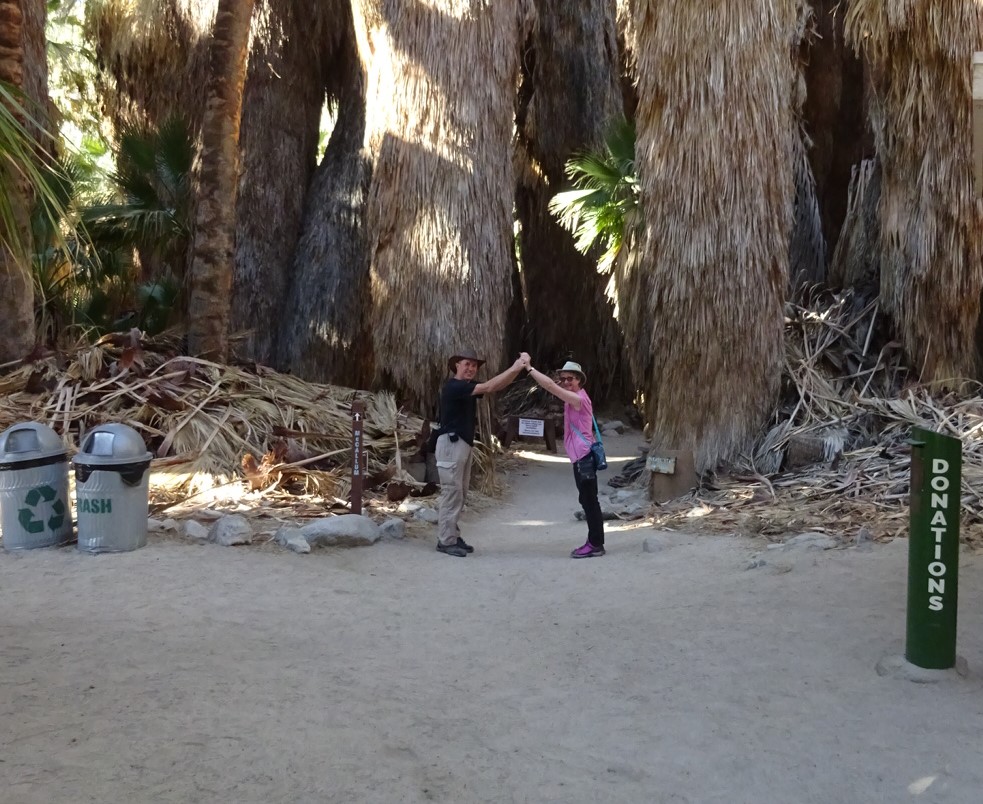
Today we went to the Coachella preserve or 1000 palms oasis. There, surrounded by desert, is an amazing area of palm trees, because although we are in the desert and it doesn’t rain, they do have a huge aquifer. All the rain from the Joshua Tree Park gathers underground at the point where the Pacific and N.American tectonic plates meet (the San Andreas fault), and bubbles up, forming little oases in the desert. We did have our photograph taken with one of us on each plate, ‘sharing the fault ‘ I’m not sure the guy quite got it when I said, “no, it’s his fault! Always his fault!” Anyway we had a good little walk, met some lovely people and had a great chat before heading back for something to snack on. Except we had to do a diversion, the fan in the car wasn’t blowing, we were getting hotter, don’t know what the problem is, it’s worked fine up until now, and tomorrow we go to Death Valley, where AC is a must! We changed the fuse, it wasn’t that. We stopped at 3 garages who looked at us as if we were nuts. It’s Friday afternoon, we might be able to look on Monday.... number 4 however said he could have a look, hurrah, $290 later, a new blower is in and all is good! We could really do without that sort of excitement!

Just along the peninsular is a rocky area with a lot of tide pools formed when an ancient seabed was pushed upwards. This photo shows many layers of sediment laid down over thousands of years. Those bottom layers are very ancient sediments, I wonder what fossils lay within them

Tomorrow we head towards Death Valley, are staying at one of our most expensive hotels, the Delight's Hot Spring Resort, where we don’t have WiFi, and we don’t have a shower in the room! There are showers, but they are outside by the thermal pools! It’s surprising what we’ll pay for! So there may only be one more blog before we head home a week on Monday, it’s all happening very fast...

A little hermit crab scuttles along in a tide pool

Tuesday's visit to the USS Midway, an aircraft carrier retired in 1992, now a museum. It was the flagship in the first Gulf war of 1991. Its our first time aboard a carrier and it is huge!

Here it is from the front, taken on our harbour trip the following day

And from another angle. It was a really interesting visit as there were many ex servicemen giving talks on various aspects of its operation (the call then Docents over here) 

Receiving a talk in one of the operations rooms

Up on the flight deck which is just immense. The white line is the track (now covered over to protect it) down which the catapult with jet attached hurtles down to launch the jet. It accelerates from 0 to 170mph in 2 seconds!

I know you'll be interested in this, so I'm going to explain the basics (it took our docent about 30 minutes). On the floor in front of the wheel is the shuttle. That was attached to a piston under the deck that, when a valve was opened unleashed 600psi expanding steam which propels the shuttle down the runway to launch the plane. This system was a British invention. See the white bar above? That's the towbar and thats lowered down to engage with the front of the shuttle. When the shuttle stops the plane can continue to move forward. 

Just before the catapult is operated the pilot must put his jet into full power, which means it has to be held back until the moment the catapult operates. To do that they use a restraining arm that attaches into that grey bit hanging down 

Here's the restraining bar. At the front is a headed pin that engages with the bit on the wheel of the jet. The T piece at the other end engages into a slot on the deck. The headed pin is designed to shear at at certain tension, with engines on full power its at its maximum, the firing of the catapult is enough to shear the pin and this bar drops to the floor releasing the catapult and jet. Off it goes down the deck to launch

A model of the guy who stood on deck to indicate to the pilot and catapult operator that's its 'go'

What about when they come into land? Every jet is fitted with a hook that can be dropped down as shown by hydraulics. They have three wires across the deck, you can see a bit of one there. They were 5 inches above the deck. The first one shouldn't be used, it's there in case the jet is a bit too low on landing. They aim for the second one, but if the miss that as they are a bit too high, there is the third one. At the moment of touching the deck they put their engines back on full power as, if they miss all the ropes they can take off again. They only shut down when someone signals they have engaged the rope correctly. Those ropes are therefore stopping a jet on full power!

To help the jets come in at the correct height they use another British invention, the Fresnel Lens Optical Landing System. Here it is. When lit the jet can see the horizontal green lights and must adjust his height to the five vertical lights in the centre. They would all be lit but angled so he can only see one depending on his height. He must adjust his height so he can see the middle one level with the horizontal green line. You can read more about it here

Here we are up on the bridge on the 'island'

And down in the engine room, plus many. many more rooms including the admirals cabin, but I won't show you any more. Suffice to say, it was a really interesting day

On our walk into the Gaslamp area we walked past the Kansas City Barbeque pub which is the very pub featured in the original Top Gun film, so we had to go in

Apparently that's the original piano used in the film

And there's the bar

Forgot to mention this helicopter on the deck of the USS Midway. This is the very helicopter that retrieved the astronauts from Apollo 8, 10, 11, 12 and 13 command modules from the sea when they splashed down

There's the badges that confirm it

Next day we went to the Maritime museum, another fabulous day. The museum is actually an old steam ferry, the Berkley, s here behind that elegant yacht. Surrounding it are seven other old ships. The elegant yacht is one of them, the Media. Built in 1904 in Scotland

The USS Dolphin submarine. We went on all of these

The magnificent Star of India, that still sails and is the oldest sailing ship still sailing in the world,  launched in 1963. It was originally the Euterpe and used by the British to transport emigrants to Australia. It circumnavigated the world no less that 21 times via the notorious Cape Horn
This is the HMS Surprise and has been used in a number of movies, the most notable being Master and Commander, starring Russel Crowe, when it was transformed into the HMS Rose. It was also used in Pirates of the Caribbean 4

This is a replica of the San Salvador, the flagship of Joao Cabrillo on his first voyage to San Diego. It was built between 2011 and 2015 near the landing spot of Cabrillo and sailed here

We did our harbour cruise on this boat, its a Swift boat, the type used in the Vietnam war to patrol the Mekong Delta. More than 800 were built and this is one of the only ones left. You can read about their part in the war here

Here's a photo of one on duty in the Mekong


Off on our tour of the harbour and here's an active aircraft carrier

Under the bridge connecting San Diego to the Coronado peninsular

A bit of Britain again, its a ship in a BAE systems dry dock

Down there is another aircraft carrier

See that ship numbered 1001? Its one of only three stealth battleships built to evade radar. You can't see much of it as its partly hidden by ship 59, but look at the strange control tower just poking above ship 59

Lots of armoured vehicles and tanks being loaded onto that cargo ship. Not sure whether I should have been taking these photos or not, but no-one said I couldn't

San Diego skyline from our boat

So now we're in Palm Springs which is basically desert everywhere, except for areas where there are springs, caused by water flowing down underground from the high Sierra Nevada mountains. The water would happily carry on underground, but it gets stopped by the San Andreas fault line which passes by here. At that point the water is forced to the surface to form an oasis. In this photo, so we were told, we are standing right on the fault line. On the left I am standing on the Pacific plate which is moving away from the camera, Jackie is on the North American plate which is moving towards the camera. The water bubbling to the surface has produced this amazing oasis in the desert with these huge fan palms

Its dry dessert everywhere, but here water flows, trees grow and birds and animals thrive

The fruits of the Far palm, similar to the date palm but less flesh. Birds and coyotes love 'em

We think this is a Phainopepla bird. I tried to get a photo as he flew away, but I just got sky!

We set off beyond the oasis into the desert, hoping to see some bobcats, roadrunners or snakes, but saw nothing. See our Relive video with more photos of our walk: click here

These ants were hard at work excavating this hole. It doesn't show on this photo, but some of the grains were shining a gold colour. Whether it really was gold I don't know, maybe there's treasure down there!

Saw this rather lovely dragonfly on the boardwalk as we came back through the oasis

On the way to Palm Springs we detoured to the Salton Sea, which is the largest inland body of water in California, but it has a toxic history. Its more than 200 feet below sea level and is an ancient seabed that got separated millions of years ago. In 1901 some people built a waterway to divert water from the Colorado River for agriculture. Unusual floods in 1905 caused the waterway to break and water from the Colorado ran uncontrollably into the dry basin for 18 months, at times causing the level to rise by 7 inches per day. Eventually the levee was repaired and the flooding stopped at a cost of $3,000,000 in 1905 money. The only water that runs into it now is runoff from the agricultural land. The water contains salt, pesticides and fertiliser, but is nowhere near enough to keep pace with evaporation. The sea is receding and, with it, the salinity is increasing. It is now 28% saltier than the sea, but also contains toxic chemicals from agricultural runoff. Most of the fish have died and rotted in the water. The result is a fairly toxic mix that resulted in the area becoming a ghost town. Abandoned yacht clubs, playgrounds and piers dot its shores and no-one really has any idea what to do with it. Colorado water is a precious resource in this drought stricken state, so that's not an option. These hay bales have been placed in an effort to keep the wind from blowing the toxic sand around. Various proposals have been put forward from pumping the water out and replacing it with sea water 80 miles away to building a desalination plant to reduce the salt content. All this would cost huge amounts of money, it's probably easier to ignore the problem, but meanwhile it festers here in an accidentally created sea that is getting more toxic by the day